What a New York Helicopter Tour Is Actually Like
From the weigh-in to the moment you lift off the East River, here is what actually happens on a New York helicopter tour, minute by minute, from someone who has watched hundreds of them.
 By Michael Torres, New York helicopter tour specialist

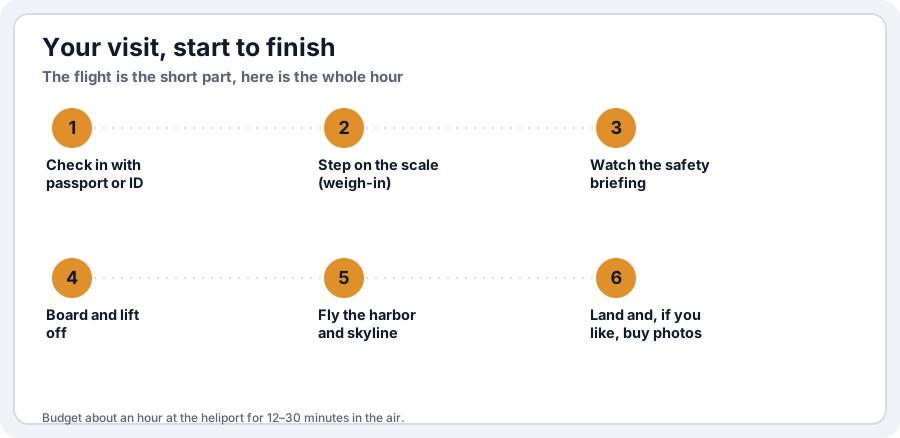
The first thing I tell people is that the flight is the short part. By the time the skids leave the pad, the experience is already half over, and almost nobody expects that. I have stood at the Downtown Manhattan Heliport more times than I can count, watching first-timers go from fidgeting in line to grinning through the glass, and the arc is always the same. Here is how the morning actually goes, so none of it catches you off guard.
The heliport, before you fly
You arrive to a small, businesslike building on the East River, not an airport. The check-in is quick but real: a passport or ID card, a security screening, and then the part that surprises everyone, the scale. Every passenger is weighed. It is not personal and it is not optional. The pilot needs the real numbers because seating is arranged by weight, so the aircraft stays balanced. There is a firm 275 lb cap per seat, and it is enforced here rather than argued about later.
Then the briefing. A short safety video plays, in English, French, German or Spanish, and a crew member fits you with a noise-canceling Bose headset. Put it on properly. It is the difference between hearing the pilot name the Chrysler Building and hearing nothing but rotor. People underestimate how loud a helicopter is until the door closes.
Lift-off
Walking out to the pad is the moment the trip becomes real. The rotor is already turning, the wind pushes at you, and a crew member walks you to your assigned seat, because remember, you do not choose it, weight does. You buckle in, the pilot's voice comes through the headset, and then the ground simply drops away. There is no runway, no roll, no gathering speed. One second you are on the East River pad, the next the water is beneath you and the city is tilting into view.
That first ten seconds is the part every passenger remembers. The helicopter rises and banks at once, and Lower Manhattan swings across the window like a set piece.
The route, out the window
The flight tracks south over New York Harbor first. The Statue of Liberty comes up on one side, smaller than you expect and then exactly the right size, with Ellis Island just beyond. If seeing them from the air leaves you wanting to stand at their feet, that is a separate trip: you can book the ferry to both islands here. The pilot talks the whole way, pointing out what is coming before it arrives, which trains your eye. Then the aircraft turns back up the island and the skyline unrolls: the Financial District towers at the tip, the long green rectangle of Central Park in the distance, the Empire State and Chrysler buildings catching the light, the bridges stitching Brooklyn to Manhattan across the East River.
Twelve to thirty minutes, depending on the option you booked, and it goes fast. I always tell people to spend the first half just looking and the second half taking photos, because if you shoot the whole time you watch New York through a screen. Shoot without flash, brace the camera against the window frame, and let the pilot's narration tell you when the next landmark is about to appear.
Landing, and what stays with you
The touchdown is as gentle as the take-off was sudden. You settle back onto the pad you left, the rotor winds down, and a crew member walks you back in. In-flight photos are offered for sale afterward if you want them; they are not part of the fare, and there is no pressure. Most people walk out quieter than they walked in, still rearranging the city in their heads.
What stays with you is not any single landmark. It is the shift in scale, the way a place that felt overwhelming from the sidewalk becomes a legible, beautiful shape from eight hundred feet up. That is the thing you cannot get from an observation deck, and it is why, after all the flights I have seen, I still think it is worth doing once. If you want the full practical detail, the route, the weigh-in, and where you take off, it is all on the tour page.